← Back to the Homeowner Resource Library
Planning Your Remodel
Post Tension Slabs
and Bathroom Remodeling
By Advanced Custom Renovations · Homeowner Resource Library
Moving a drain, adding a shower drain, creating a curbless shower, or placing a freestanding tub where one did not exist may require opening or modifying the concrete beneath your bathroom. If your home has a post-tensioned slab, that work takes additional planning. A remodel can still be possible, but scanning and careful demolition cannot remove every risk.
What are post tension cables
Post-tension cables, also called tendons, are high-strength steel strands embedded in concrete and tensioned after the concrete reaches the required strength. They help the slab carry loads and control cracking. In many residential systems, the strand has a protective sheath and corrosion protection. Damaging that protection can matter even if the cable is not cut.
These cables hold substantial force. An accidental strike can affect the tendon system and create a serious safety hazard. Concrete cutting in a post-tensioned slab belongs in the hands of qualified professionals. A surface mark is not permission for a homeowner to drill or cut.
When a bathroom remodel may involve the slab
Slab work may be needed to move a toilet or shower drain, add a drain, change the plumbing for a freestanding tub, or create the recess needed for some curbless shower designs. The amount and location of concrete removal depend on your existing plumbing, the proposed layout, and the slab itself. Some layouts can use existing drain locations and reduce the amount of slab work.
What a concrete scan can tell us
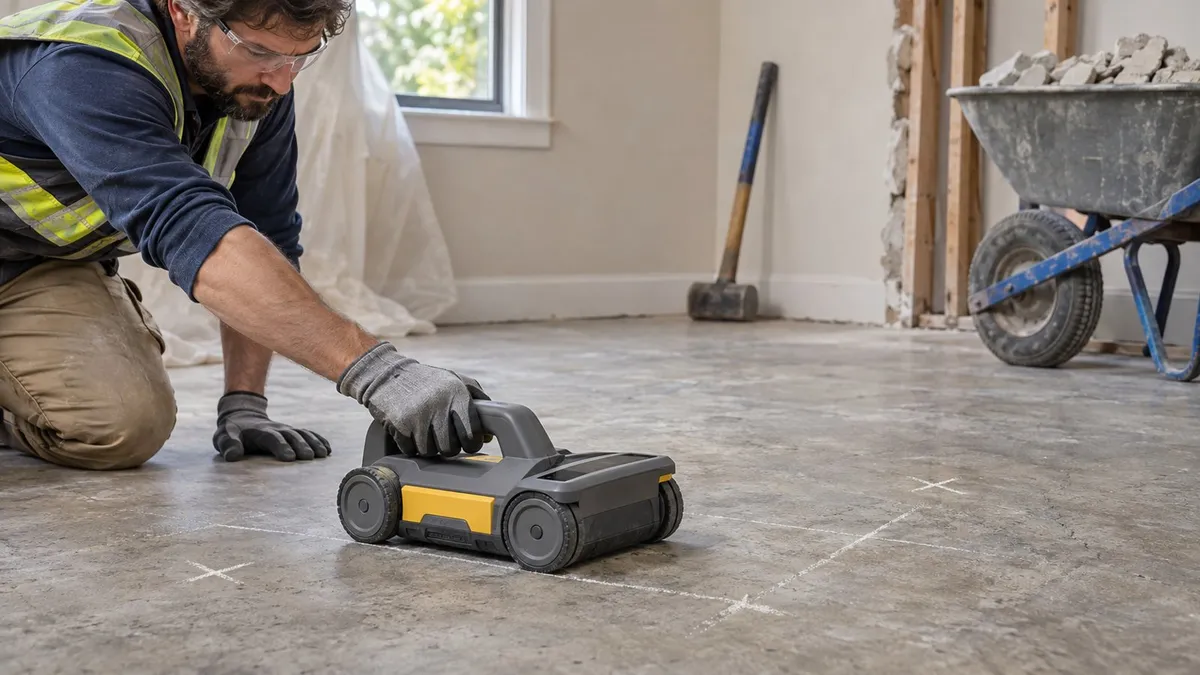
A scan helps identify the location of post-tension cables and other concealed items, but it does not provide a complete view inside the concrete. Cable placement and depth can vary, and we cannot always determine how close a cable is to the surface. Scanning supports planning and careful demolition, but it cannot guarantee an exact location or depth, identify every concealed item, or eliminate the risk of damage during the work. Closely spaced steel, overlapping objects, and surface obstructions can limit what is detected. We cannot promise an exact location, exact depth, or that every concealed item will be found.
Why we do not assume a cable depth
Every slab must be considered on its own. Tendon placement depends on the design, slab geometry, and actual construction. Prior repairs or modifications can add uncertainty. A six-inch slab does not give us a guaranteed three-inch cutting clearance. We plan around the information available for your home rather than a rule of thumb.
Arizona projects are subject to applicable local building requirements and professional workmanship standards. That does not mean all homes share one cable layout or that we can confirm concealed construction from the builder’s name or the age of the home.
How ACR approaches the work
We review the proposed plumbing changes, arrange scanning before slab demolition, and use the findings to plan the work. If the scan leaves uncertainty or the proposed opening conflicts with a tendon, the next step may be more investigation, a different layout, or specialist and engineering input. Scanning does not replace structural evaluation when the proposed work requires it.
Our goal is to make the changes your bathroom needs while keeping slab disturbance as limited as practical. Planned tendon cutting, relocation, or changes to the structural system require specialist involvement and appropriate engineering; they are not ordinary plumbing demolition.
If a repair becomes necessary
Scanning and careful demolition help us plan the work, but they cannot eliminate the possibility of damage to a cable or its protective covering. If damage occurs during demolition, we stop work in that area, take immediate safety precautions, and notify you. A qualified post-tension specialist assesses the damage, with engineering input when needed. We explain the recommended repair, its cost, and any effect on the schedule before proceeding under a written change order.
Before slab demolition begins, we review the remaining risk with you and explain how any necessary inspection, repair, and restoration costs would be handled under your written agreement and acknowledgment.
Why we do not automatically charge for a repair
We believe you should understand the risk without automatically paying for a repair your remodel may never need. Unless your estimate expressly includes an allowance, ACR does not build a tendon-repair charge into your project price. We plan carefully, explain the possibilities up front, and work through any necessary additional work with you if it arises. No needed repair means no added repair charge.
Planning your bathroom remodel
A post-tensioned slab is a detail to plan around, not an automatic end to your bathroom plans. During your estimate, tell us whether you know the slab is post-tensioned and share any foundation plans, scan reports, or records of previous slab repairs. We can review your proposed drain locations and discuss what needs investigation before the layout is finalized.
Have a bathroom change in mind? Schedule an estimate with Advanced Custom Renovations so we can talk through the layout, the slab work it may involve, and the questions to resolve before demolition.
Schedule your bathroom estimate →
Further reading
Post-Tensioning Institute guidance on existing slab openings
GPRS answers about scanning and depth estimates
ScanXConcrete scanning limitations
General homeowner information. Project-specific evaluation and your written remodeling agreement govern the work and cost allocation.
